Is a one-page website good for a small business?
When one page beats a ten-page site, where the classic one-page site loses in search, and how a living surface gives people one page and gives crawlers many.
By Lance Culbreth, founder of Fraya · · 5 min read
Short answer
Yes, if it is built so people get one page and machines get many. A one-page site is easier to visit, easier to keep current, and faster to launch. Its weakness is search: one URL and one title cannot rank for every topic. The fix is to keep the business on a single living surface for visitors while every product, post, and event also has its own server-rendered URL with structured data. That is how Fraya builds every site.
What a one-page site gets right
Most small businesses have five things to say: what they make, what it costs, where and when, who they are, and how to reach them. A ten-page site spreads those across a menu and asks the visitor to go find them. A one-page site puts them in a scroll, in the order a first-time visitor needs them.
- Nothing to navigate. The visitor reads down instead of guessing which menu item holds the answer.
- One link to share. Instagram bios, text messages, and business cards all point to the same place.
- Phones are the default. A vertical scroll is what a phone already does, so the mobile site is not a smaller copy of the desktop one.
- Nothing goes stale in a corner. There is no About page from 2023 that no one has looked at since.
What it gets wrong, in search
This is the objection, and it is fair. A search engine ranks pages, not businesses. A page has one title, one description, and one main topic. If your whole business is one page, that page has to rank for your name, your product, your service, your city, and every question a buyer might ask, and it will lose most of those to pages that are about one thing.
AI assistants have the same problem in a different shape. When someone asks a model to recommend a candle maker in Portland, it looks for a page that says exactly that, with the entity, the offer, and the location in one readable document. A page that has everything but is structured as a wall of text gives the model little to lift.
The fix: one page for people, many for machines
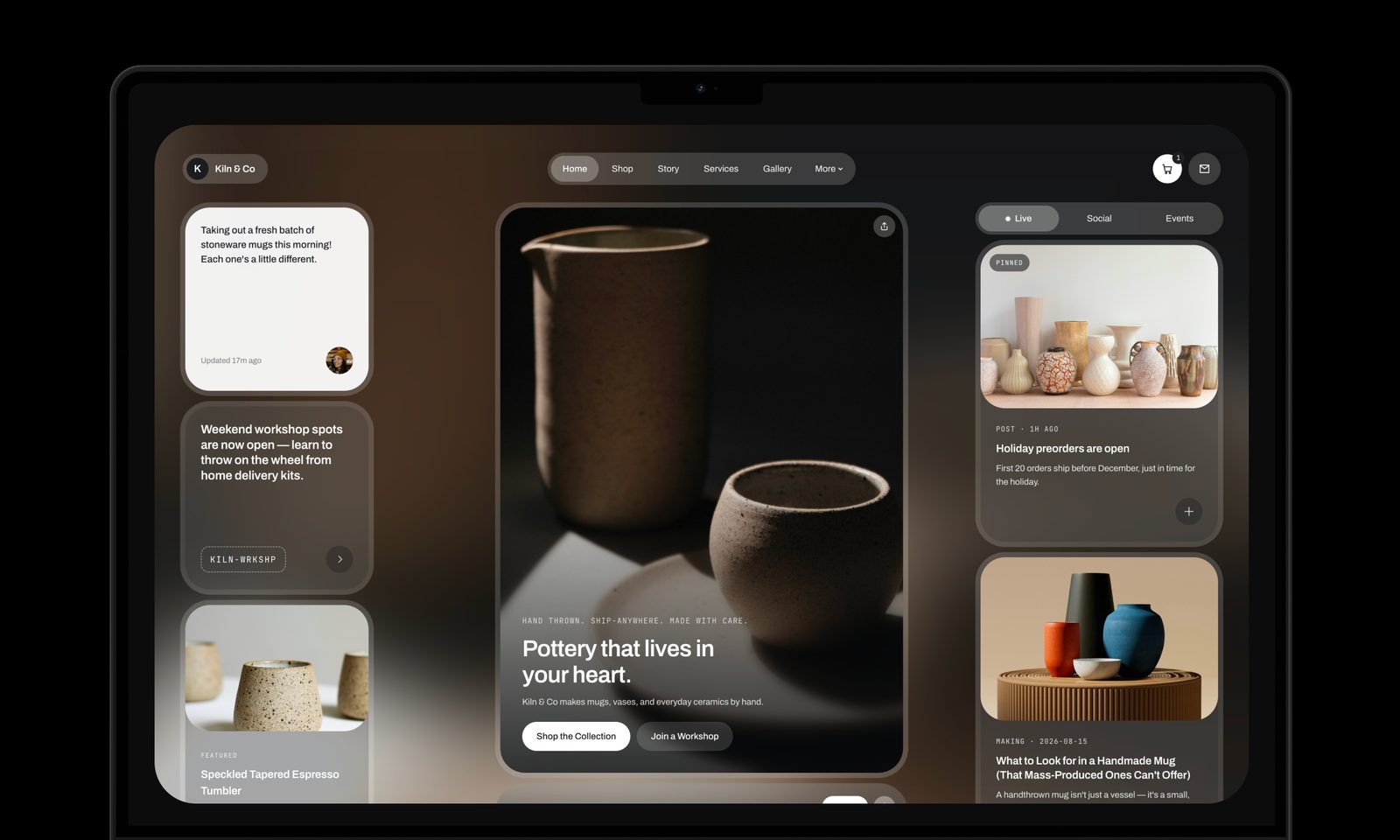
The living surface Fraya publishes is one scroll for the visitor. The business, the latest note from the owner, the shop, the story, the services, the events, and the contact form sit on it in order, and the shop and posts open in place without a reload. Underneath, each product, blog post, and event also has its own address, server-rendered, with a title, a description, and structured data of its own.
- The living surface carries the business entity: name, what it does, where, hours, reviews, and the offer, marked up as structured data in one document. That is what an AI assistant wants when it decides whether to cite you.
- Each product page carries the product: name, price, availability, and images, marked up as a Product. That is what shopping results want.
- Each post carries one topic with a date and an author, marked up as an Article. That is what long-tail searches want.
- Everything renders on the server. A crawler that does not run JavaScript sees the same words a visitor does.
A one-page site done this way is not a compromise. The visitor gets the simpler site. The engines get more pages than most ten-page sites give them, each one about a single thing.
The advantages you do not see
- Fewer pages means each crawl goes deeper. Search engines budget how much of a site they read; a dense living surface plus clean detail pages uses that budget well.
- No dead links accumulate. A menu of pages drifts as a business changes. One page cannot link to something that no longer exists.
- The business facts never disagree with themselves. Hours, address, and phone live in one place and flow to every detail page and to the structured data.
- Weight stays honest. A single page has to load fast, so images ship in sizes matched to the screen and heavier sections load as you reach them.
When you still want more pages
Some businesses need real sections: a restaurant with three locations, a firm with six distinct services that each earn their own search traffic, a publisher with hundreds of articles. Fraya handles the articles and the products as their own pages already. If the business is genuinely several businesses under one name, that is the case for a larger site, and a fair reason to choose a different tool.
Straight answers.
Do one-page websites rank on Google?
They rank for the business name and a small number of terms. They lose on everything else, because one page cannot be about many topics. Giving products, posts, and events their own server-rendered pages under the same domain fixes most of that.
What does Fraya call its version?
A living surface. It is one scroll for the visitor that updates like a feed as the owner posts, sells, and books, with a real page underneath for every product, post, and event.
Can visitors still share a single product or post?
Yes. Each has its own address that opens the living surface with that item in front, and the address is what search engines and social previews use.
Is a one-page site faster?
It can be, and it has to be. Everything a visitor might want is on one load, so the page ships images in sizes matched to the screen and loads heavier sections as you scroll to them.